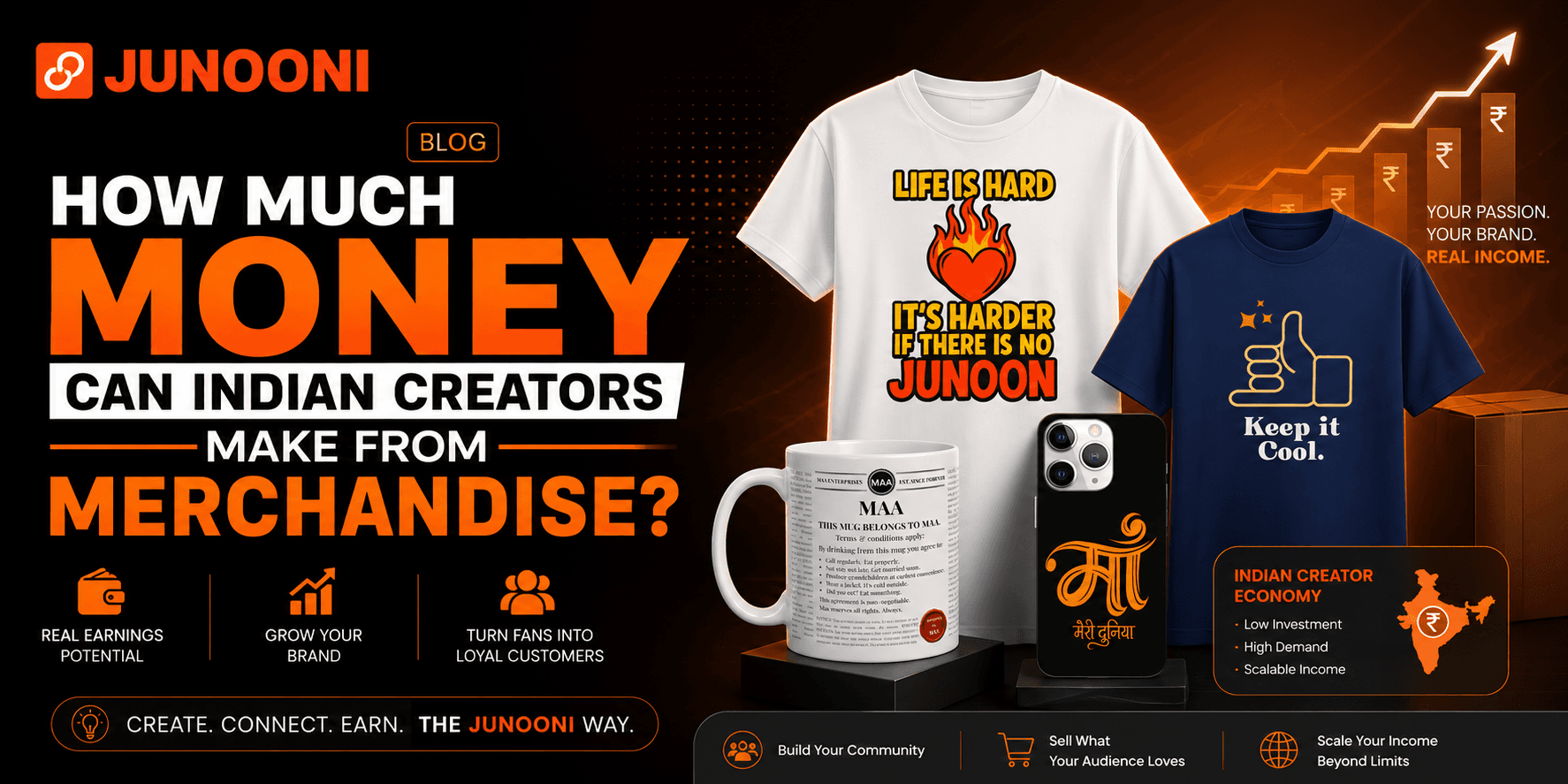
Indian creators can realistically earn ₹4,000 to ₹50,000 per merchandise drop with an audience of 10,000 to 50,000 engaged followers, and ₹1,00,000 to ₹20,00,000 per month at audience sizes of 1,00,000 to 5,00,000+. Typical profit per unit ranges from ₹70 for low-cost items like stickers to ₹584 for a premium t-shirt, depending on the product and retail price. These figures assume a print-on-demand model with no upfront inventory — like the one used on JUNOONI — where a creator keeps 90% of the post-production margin starting from 0% platform commission. The rest of this article shows exactly how these numbers are calculated, so you can estimate your own potential earnings before launching anything.
Why Merchandise Is Becoming a Major Creator Revenue Stream
For most of the last decade, Indian creators have relied on two primary income sources: platform ad revenue (AdSense, YouTube Shorts fund) and brand sponsorships. Both have a structural weakness — neither is owned by the creator. Ad revenue depends on a platform's algorithm and advertiser demand. Sponsorship revenue depends on a brand's budget cycle and requires fresh negotiation for every single deal.
Merchandise solves both problems. It is a creator-owned revenue stream — the pricing, the product, and the customer relationship belong entirely to the creator, not to a platform or a brand. Once a merch store is live, every sale is a direct transaction between the creator and their audience, with no algorithm or advertiser standing in between.
Here is how the three main creator revenue streams compare structurally — see our dedicated creator merch vs brand deals breakdown for a deeper side-by-side:
| Revenue Stream | Who Owns It | Recurring? | Requires Renegotiation? |
|---|---|---|---|
| Ad Revenue (AdSense) | Platform-dependent | Partially | No, but rates fluctuate |
| Sponsorships | Brand-dependent | No | Yes, every deal |
| Merchandise | Creator-owned | Yes | No |
This is not a claim that merchandise should replace sponsorships or ad revenue — it should not. It is a claim that merchandise fills a gap neither of those two streams can fill: a recurring, creator-controlled income source that compounds as the audience grows, rather than resetting every month.
Creator Merchandise Profit Formula
Every merchandise earnings estimate in this article — and every estimate you should trust from any source — comes down to one formula:
Applying this formula to a real example — an oversized t-shirt sold through a typical print-on-demand model:
The same formula, applied at different retail prices, produces the profit-per-unit figures used throughout the rest of this article:
| Product | Selling Price | Est. Profit/Unit |
|---|---|---|
| T-Shirt | ₹599 | ₹224 |
| T-Shirt (Oversized) | ₹799 | ₹404 |
| T-Shirt (Premium) | ₹999 | ₹584 |
| Hoodie | ₹1,299 | ₹539 |
| Crop Top | ₹599 | ₹251 |
| Cap | ₹499 | ₹180 |
| Mug | ₹399 | ₹160 |
Real Earnings Examples — By Audience Size
These examples use three realistic conversion-rate scenarios — conservative (0.1%), average (0.3%), and strong (0.5%) — applied to a single oversized t-shirt drop at ₹799 (₹404 profit per unit). Conversion rate is the percentage of a creator's audience who actually purchase during a single drop, and it depends heavily on engagement quality, not just audience size.
These figures represent a single drop, not a monthly figure. Most active creators run one to two drops per month — so monthly earnings can realistically be double the per-drop numbers above, particularly once a creator has multiple products and repeat buyers.
"A 10,000-follower creator with a genuinely engaged audience can out-earn a 1,00,000-follower creator with passive subscribers. Conversion rate, not follower count, is the real driver of merchandise revenue."
Earnings Calculator Tables — Monthly Orders vs Profit
Use this table to estimate your own monthly merchandise profit based on how many units you expect to sell across four common product categories:
| Monthly Orders | T-Shirt (₹404/unit) | Hoodie (₹539/unit) | Mug (₹160/unit) | Cap (₹180/unit) |
|---|---|---|---|---|
| 10 | ₹4,040 | ₹5,390 | ₹1,600 | ₹1,800 |
| 25 | ₹10,100 | ₹13,475 | ₹4,000 | ₹4,500 |
| 50 | ₹20,200 | ₹26,950 | ₹8,000 | ₹9,000 |
| 100 | ₹40,400 | ₹53,900 | ₹16,000 | ₹18,000 |
| 250 | ₹1,01,000 | ₹1,34,750 | ₹40,000 | ₹45,000 |
| 500 | ₹2,02,000 | ₹2,69,500 | ₹80,000 | ₹90,000 |
To estimate your own number: take your expected monthly order count for a product, multiply it by the per-unit profit figure above, and that is your realistic monthly merchandise profit for that single product. Most creators sell more than one product per drop, so combining a t-shirt and a cap, for example, simply adds both rows together.
Factors That Affect Merchandise Earnings
Two creators with identical follower counts can earn wildly different amounts from merchandise. The five factors below explain why:
Common Mistakes Creators Make
Avoiding these mistakes is just as important as getting the product and pricing right — see our full guide to the biggest problems creators face launching merch for an extended breakdown.
Merchandise vs Sponsorship Revenue
Sponsorship rates in India vary by audience tier, and unlike merchandise, every sponsorship deal is a one-time payment that must be renegotiated from scratch:
| Audience Size | Typical Sponsorship Rate | Merch Profit Potential (per drop) |
|---|---|---|
| 10,000–50,000 | ₹2,000–₹15,000 per post | ₹4,000–₹60,600 |
| 50,000–5,00,000 | ₹15,000–₹1,00,000 per post | ₹20,200–₹6,06,000 |
| 5,00,000–20,00,000 | ₹1,00,000–₹5,00,000 per post | ₹2,02,000–₹10,10,000 |
The key structural difference is not just the rupee figure — it is what happens after the deal closes. A sponsorship payment is final; earning the same amount again requires finding and closing a new brand deal. A merchandise drop can be repeated the following month with the same design, the same audience, and no renegotiation required — this is the same compounding effect we cover in detail in how creators build passive income from merch. Over a 12-month period, this compounding effect is usually what separates creators who treat merchandise as a side project from those who treat it as a real business line.
Most successful Indian creators do not choose one over the other — they run sponsorships for short-term cash flow and merchandise for long-term, owned revenue, in parallel.
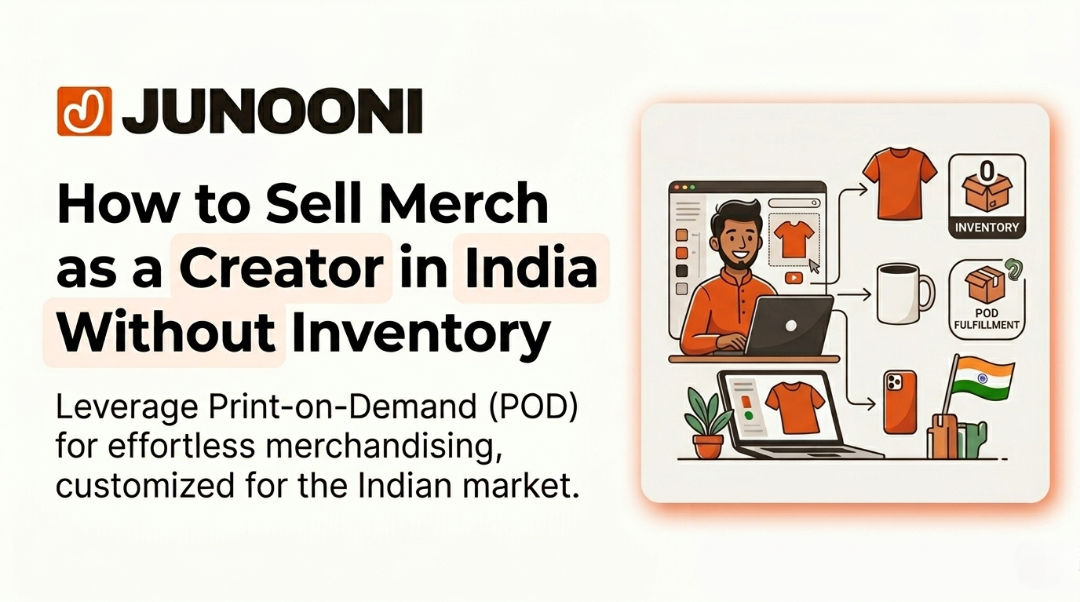
- No inventory management — products are printed only after a fan orders, so there is no unsold stock risk built into any of the figures above.
- No production setup — fabric sourcing, printing, and quality control are handled by the platform, not the creator.
- No fulfillment handling — dispatch, delivery, and customer service on every order are managed end-to-end, so the profit figures above are close to take-home, not gross revenue before hidden operational costs.
Estimated Monthly Revenue by Creator Type
Industry benchmarks across creator-commerce platforms show that revenue potential also varies meaningfully by content niche, not just audience size. The table below estimates monthly merchandise revenue for a creator with 50,000 followers, assuming a 0.3% average conversion rate on a single product priced around ₹799–₹999:
| Creator Type | Typical Product | Est. Monthly Revenue (50K audience) |
|---|---|---|
| Gaming / Streaming | Hoodies, Mousepads | ₹45,000–₹75,000 |
| Music / Performing Arts | Oversized Tees, Posters | ₹50,000–₹90,000 |
| Comedy / Stand-up | Tees, Caps | ₹40,000–₹70,000 |
| Fitness / Wellness | Tanks, Shakers | ₹35,000–₹60,000 |
| Education / Coaching | Notebooks, Hoodies | ₹30,000–₹55,000 |
| Podcasting | Mugs, Tote Bags | ₹25,000–₹50,000 |
These ranges are directional, not guaranteed — a niche with a strong community culture (gaming, music) tends to outperform a niche with a more passive audience relationship at the same follower count, which is consistent with the engagement-rate factor discussed earlier in this article.
Case Study — A Mid-Tier Creator's First Drop
To illustrate how the formula plays out in practice, consider a hypothetical but realistic example: a music creator with 42,000 Instagram followers and a moderately engaged community launches a single oversized t-shirt design priced at ₹799.
This outcome sits close to the "average" conversion-rate scenario used earlier in this article for a 50,000-follower creator, which is a useful sanity check: a creator's actual results should land somewhere between the conservative and strong scenarios shown in the earnings tables above, not at the extreme edges of either.
Methodology
- The profit calculations in this article are based on a creator merchandise pricing model representative of platforms operating in India as of June 2026, including the structure used by JUNOONI.
- Conversion-rate scenarios (0.1%–0.5%) are illustrative estimates based on creator-commerce and ecommerce industry benchmarks, not a guarantee of results for any individual creator.
- Sponsorship rate ranges are drawn from publicly reported Indian influencer marketing rate cards across nano, micro, and mid-tier creator segments.
- Actual results vary depending on audience engagement, niche, pricing, product selection, promotion strategy, and seasonality, and should be treated as a planning reference rather than a forecast.

-01KS9W4GSYWNJXDDFGTND3AE1B.png)